Tuesday, 19 July 2016

MAKING MY 21C SKILLS VIDEO

That was so much fun... NOT the videoing myself part, but the actual creation of a text, a video, making a movie using i-movie, then editing, adding some start slides and music even. I consider myself quite clever now. LOL 

It took a while to really settle on the script as I had so much to say and only 3 minutes to say it all in. Then I discovered at the end that my video was over 3 minutes long... a NO NO... so back to the editing suite I went.

Then it took over an hour to upload to YouTube. OMG - I thought I'd lost it. No stress - it is there somewhere, somewhere!

Ta daaaaaa! Here is is

Keri's 21stC Skills Learning Journey

Monday, 18 July 2016

WEEK 3 - LEADERSHIP - IMPLEMENTING TECHNOLOGY INNOVATION

Flipped Preparation:

Read CONDITIONS FOR CLASSROOM TECHNOLOGY INNOVATIONS

Notes: There are 11 salient factors that impact the degree of success.

1. INNOVATOR
  • Technology Proficiency

  • Compatibility between Teacher Pedagogical Beliefs and the Technology
  • Social Awareness
2. INNOVATION
  • Distance from school culture
  • Distance from existing practice
  • Distance from available technological resources
  • Dependence on others
  • Dependence on technological resources
3. INNOVATION

WEEK 3 - DIGITAL - TECHNOLOGY DISRUPTION AND MIXED REALITY

Whakatauki
Ka mate te kāinga tahi, ka ora te kāinga rua.
There is more than one way to achieve an objective.


Successfully downloaded; Aurasma, Quiver, Anatomy 4D and Enchantium onto my i-Pad this afternoon.

WEEK 2 - LEADERSHIP TASKS - Reflective Practice, Key Competencies

  • Reflect after (optional): How might teachers’ and students strengths in developing capabilities in thinking, using language, symbols and texts, managing self, relating to others, and participating and contributing, be recognised and celebrated?

Tuesday, 12 July 2016

WEEK 2 DIGITAL TASKS - 21st Century Skills

  • Flipped preparation (required): Prepare for the session by watching the video "What 60 Schools Can Tell Us About Teaching 21st Century Skill" and reflecting how 20th century and 21st century skills differ? Do we need both?

Flipped Preparation - Teaching 21st Century Skills

OMG this was such a empowering 15.5 minutes.
I wrote so many notes 

When I think about my own schooling and think about what I remember of those days... I was educated in a mostly Industrial Age model in the 70's and 80's. I think my teachers, who were also my parents,  may have been ahead of their time - because I remember 
Industrial Age Model
CONTAINED - 
CONTROLLED - 
PREDICTABLE - 
SCALABLE -
REPEATABLE - 
MEASURABLE - 

21st Century Model
PERMEABLE - 
ADAPTIVE -
RELEVANT -
DYNAMIC -
CREATIVE -
SELF-CORRECTING -

I really like the way that Grant created the term - COGNITOSPHERE - the system of knowledge creation and management.

Personally, I believe that we have to work in both models. There are aspects of the


Our Group Task:
Skilled Communication

Wednesday, 6 July 2016

Week 1 - LEADERSHIP - Thought Leadership and Followership

  • What does the Thought Leadership mean? Who is a thought leader?
  • Sharing in a way that teaches: 
  • A thought leader is an informed opinion leader - the go-to person in their field of expertise.
  • Leadership and Followership video : What Tango teaches us about these roles in life. 

This video resonated with me as both my daughters (19 & 12) are latin and ballroom dancers.

They have learned to be responsible for their actions when dancing.
One of them was a follower fighting against the leader.
One was a weak follower.
Neither have been self serving.
What has impressed me the most about both my girls is that they have become gracefully followers, who compliment their partners and do awesome dancing together.

In my own leadership journey I have encountered:
* Weak Following - a colleague who was extremely passive, restrictive and dragging me around as her team leader;
* Self Serving - I have been there myself on occasion over the years - not interested in co-creation. I have also worked with people over the years who I felt that all I could do was stand by and watch;
* Follower fighting against the Leader - I encountered this exact thing whilst participating in some PLD. It is no fun to be made to feel weak and for colleagues to not respect the vision of the 'dance';
* Leader losing focus or balance - I have experienced firsthand when a Senior Manager (follower) has helped to refocus the Principal (Leader) which has lead to completion of the task;
* Grateful Following - This is the most awesome time when the lead is being shared together - when we are connected and creative;

I particularly liked when Sharna said :
The approach of the follower can influence the creative potential of the leader. 
Struck me as a powerful message to share.


I found a statement that sums up my belief about thought leadership.
Set a direction, build an inspiring vision and create something new. 

I found this website that gave me great food for thought.
permalink: http://uber.la/2013/11/social-media-leadership/


uber.la thought leadership

Thought leadership without the doing is just thinking.

The I've been trying to answer the question what makes a thought leader? What is "thought leadership?" How does someone become a thought leader? One of my mentors told me, "It's all about how you share the information. Are you sharing it to teach people, or to hear yourself?"
Here are 16 ideas of how to contribute your thinking. Leading is a bit more of an audience participation thing, but you CAN focus on yourself and refining your message.
  1. Blog -If you are not putting your "thinking" and "doing" down in writing, Google is not going to to know you exist.
  2. Twitter – It's fine, but make sure you know what you want from twitter, to me, Twitter is about establishing a "voice" rather than shouting a sales message.
  3. Participate – Where do you spend time online? What sites do you visit frequently? What is it about Facebook that has made it the 2nd largest destination site in the world? (Do you know who is #2? Hint: The site is owned and operated by a telecom and they don't speak English anywhere on it.)
  4. Infuse your imagination – a. read (rss feeds, tech magazines (wired, fast company, inc), b.follow some interesting tweeters(who do you look up to?), c. play the game (and games online), d. share your "thoughts," e. get experience by doing some work.
  5. Go mobile – How does your phone influence your online experience, how do you share with your phone that is different than wifi-accessed computer sharing? (80% of Tweets are generated via mobile apps and mobile sites.)
  6. Set goals – It's easy to say "be everywhere" but harder to make decisions about where to spend your time online.
  7. Embrace the long view – You can't gain 1,000 followers in 10 days, and if you could would they be followers that you wanted? Your linkedin profile is developed over years of experience.
  8. Beyond Facebook – How do you stay in touch? Where do you go to catch up on what your friends are doing? LinkedIn weekly updates? LinkedIn Groups? Friendfeed?
  9. Celebrate the amazing – The iPod and iPhone were industry changing products – study what made them special and what keeps them ahead of ALL the competition.
  10. Smart friends – gather with other online thinkers, find ways to do it differently within your peer group, your company.
  11. Network with new people – Blast beyond your close network and force yourself to attend a Tweetup, a BarCamp, an industry conference.
  12. Learn, study, build – There is no excuse for not expanding your toolbox. (Lynda.com / Inbound Marketing University / classes and workshops)
  13. Be fierce with your competition – "New business is not about fairness." (What are they doing that we are not? What do you need to do better? How will you stand out in the crowd of smart companies, or in a company of smart people?)
  14. Connect in Real Time – The online world of social media is expanding the reach and influence of every one, time online, emails, chats, tweets are all good examples of connecting online, but don't forget, often business is done with a handshake and a face to face meeting. Look to add one personal meeting per week to your schedule (lunch, coffee, tennis, tweetup).
  15. Lead – Don't do anything tentatively. If you're going to get involved, do it with passion. If you don't have a passion for what you are doing you cannot fake it. In Seth Godin's Tribes he says, "Nobody forwards a boring email." Make sure you are injecting energy and thought into your participation.
  16. Write – If you are not capturing it, no one is going to do it for you. And how will you remember all that you learned and all you've yet to explore?

Thought Leadership Is About Participating, and Then Sharing Your Learnings With the Rest of Us. 

@jmacofearth (also seen on Google+: jmacofearth)

Week 1 - DIGITAL - Epistemology and the Purpose of Education

IN CLASS TASKS
What is Knowledge?
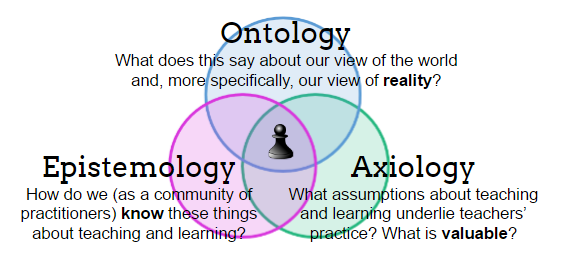
I encountered some words that were new to my vocabulary...
1. Epistemology - The study of knowledge
2. Ontology - Our ideas about reality
3. Axiology - What is valuable in our world

Source: Audi, R. (gen. ed.) (1995), The Cambridge Dictionary of Philosophy, Cambridge: Cambridge University Press.

Our group (Yin) pooled our ideas...
  • Understanding through experience
  • Isn't always correct
  • Knowing how to share and access knowledge
  • Obtained through questioning, investigating, experimenting, observing, making mistakes
  • Knowledge has become more accessible
  • Evaluating the validity of the knowledge
  • Challenges thinking
What is the Purpose of Education?

Source: 

We got together with our (Yang) buddies and developed our version of what is knowledge and the purpose of education

Knowledge is sharing, questioning, magnifying, experimenting, observing, thinking critically and evaluating, 
AND,
the Purpose of Education is to open up the local and global avenues of knowledge.

Group Task
created by Sam, Alex, Paige and I.
mostly Sam, Paige and Alex as I didn't really know what I was doing. 
Knowledge and the Purpose of Education

Reflect on how your understanding of the purpose of education is visible in your classroom. 

What is going on in my classroom? My understanding of the purpose of education.
  • Is learning visible? Is learning visible in my class... What is visible? Is it posters, wall stories, charts or is is the conversations had with my children about their learning? 
  • Am I controlling the learning? Most definitely - As a NE/Y1 teacher, I can envision the learning pathway for my children. I have to plan for them to make so much progress over the first year at school... there is a Standard that they MUST reach in order to be labelled an achieving child. What will self- directed learning look like for these children? I am on such a mission to input what they need to know that I don't have time to stop and smell the roses and go with their urges.
  • Do I give my children the opportunity to lead the learning in my class?  Quite simply NO not really. My questions are Where do I start? What do I do? What will it look like? How do I do this?
Hang on...
So if I apply what my group summarised Knowledge and the Purpose of Education to my classroom, then I think learning is visible in a variety of ways - most importantly orally for my children. 
Yes I am still controlling the learning - however, there are aspects of our day that are definitely opening up the local and global avenues of knowledge. I still direct these at this stage as we do not have 1:1 devices or shared devices in our class, BUT that is about to change in the coming terms ahead.


I want my children to become confident contributors to our class, our school, their whanau, their community and the world. 
I want then to be able to make informed choices in their lives. I want them to want to learn and keep learning throughout their lives.
I want for them a better life. I want for them to be a great as they want to be.

  As a school community we do not specifically teach the Key Competencies... They all are our kaupapa - they way we do things at EHS.
We do not target the Competencies as individual components, but as a whole, all together, all at the same time, all complementary.

Think about also how you would like to record and perhaps share your learning with a wider community?
I think that the best way for me to record and share my learning is on this blog and sharing my blog with peers.

WEEK 1 DIGITAL TASKS

My Introduction on the Mind Lab July Intake 2016 Google+ community

Kia ora tatou, Ko Keri toku ingoa. I am the DP at Edmund Hillary School in Papakura. I teach a delightful class of NE-Y2 learning sponges. I am excited to be starting my Post Grad learning journey with The Mind Lab by Unitec on Tuesday nights @ Aorere College. Time to teach an old dog new tricks!

Looking forward to making connections and networking with the SUPER CREW in Auckland South.


Session 1 Reflection
I was gutted when I realised that I had left my phone at school. It's sad how reliant I am on having my phone with me! Especially for taking photos etc. I was one of the first to arrive and I always find that a nervous and anxious time. As the team were setting up for the session I felt welcomed and was put at ease. A couple (Alex and Paige) came and sat with me and we introduced ourselves. As usual I started to make connections - Paige works at Sommerville Intermediate where my niece attends. She recognised her from my whanau photos. I was also looking forward to meeting up with my own daughter's teacher. We had not long found out that we were on this journey together. It is so good to have a buddy!

Getting started with introductions, moodle, course tasks, asking questions, meeting new friends, having a hot drink and watching videos and thinking about the questions, it was all on! There were so many things to think about and reflect upon in my on class and with my own teaching.

Best part... tutuing with PlayDoh. Creating our thinking using this fun and tactile resource. Made me think about making some more for my class. We seem to be similar thinkers - we were all on the same page... We all made valuable contributions to the discussion and I know that my vocabulary and understanding was enlightened. Then working together to create a video to represent our thinking What is Knowledge and the Purpose of Education... I felt I was not much help with this as I do not have a mac and Sam, Alex and Paige do. I will bring my school i-pad next session. :) I did manage to find a background to use in our video.

One quote I picked up on quickly... FAIL FASTER - LEARN QUICKER. So let's get started...

Tuesday, 5 July 2016

Ready, Set Go!

My Post Grad Learning Journey is finally underway this evening.
Here's my mantra for session 1.

So why have I chosen this pathway for Post Grad study?
  • Because I am ready for study. I completed the NAPP (programme) in 2014. I am ready for a new challenge.
  • Because my friend Mel started this exact Post Grad Diploma last year and during a PLG intervention, she made me take a good hard look at myself and in what direction I was heading.
  • I am eager to learn, to add to my kete, to share my learning.